
Table of Contents
Real MPG Explained: 7 Honest Facts Every UK Driver Should Know
By the John Autos Editorial Team • 9 min read • Updated June 2026
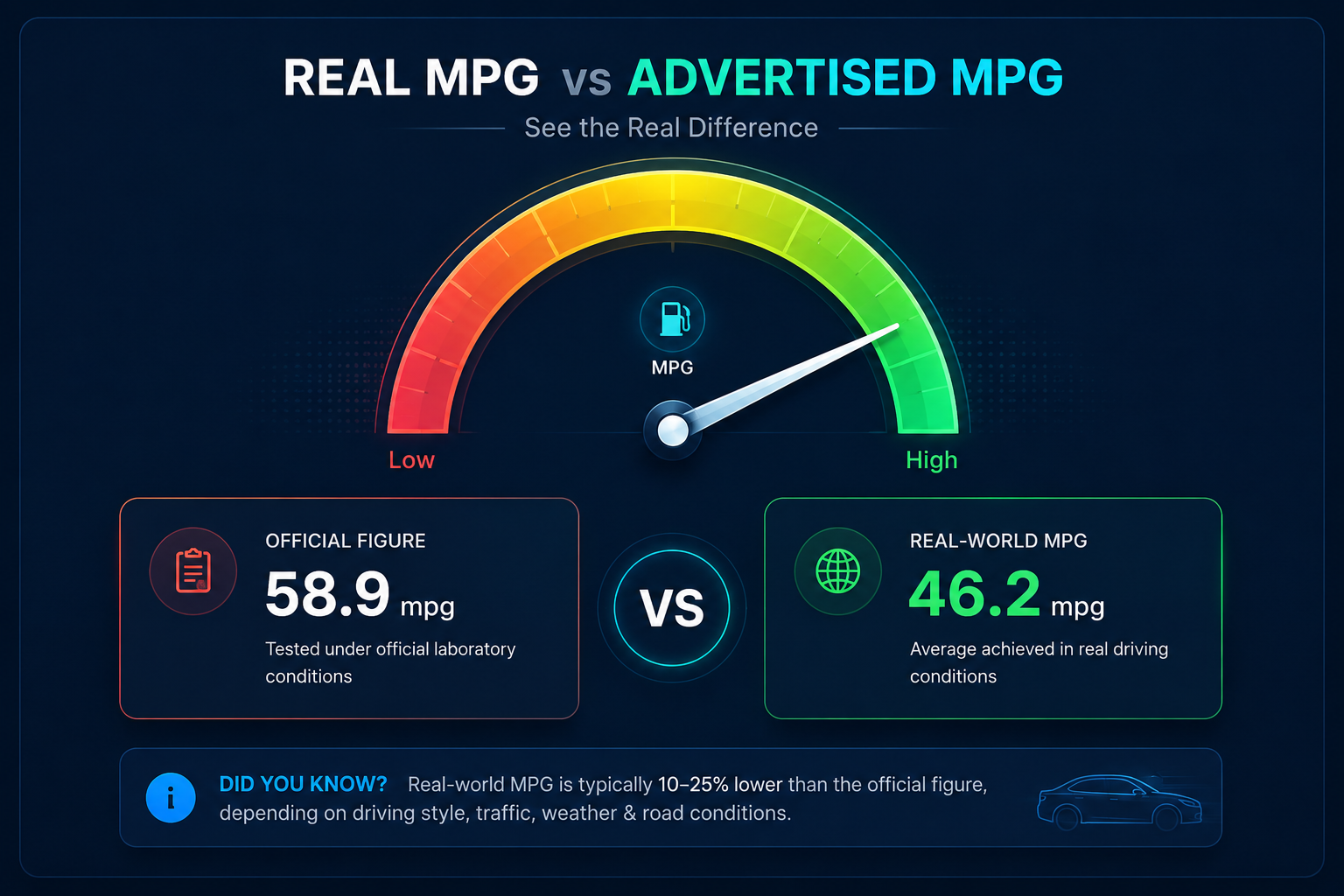
Real MPG is almost always lower than the figure printed in a car’s brochure — here’s why.
If you’ve ever bought a car expecting one fuel economy figure and got something noticeably worse at the pumps, you’ve already discovered the gap between official MPG and real-world performance. It’s one of the most common frustrations among UK drivers, and it’s also one of the most searched car-buying questions online — thousands of people type “real mpg” or “realistic fuel consumption” into Google every single month, trying to work out what a car will actually cost them to run.
This guide explains exactly what real MPG means, why the official figures rarely match it, and what you can genuinely expect at the pump for different types of car. We’ll also cover how owner-reported data is collected, why certain engine types see a wider gap than others, and the practical steps that make the biggest difference to your day-to-day fuel bills. Whether you’re comparing models before visiting our Leighton Buzzard showroom or simply trying to understand your current car’s fuel bills, you’ll come away with a clear, honest picture you can actually rely on.
What Is Real MPG?
Real MPG is the fuel economy a car actually achieves in everyday UK driving conditions, as opposed to the official miles per gallon figure quoted by the manufacturer. Official figures come from standardised laboratory testing — currently the WLTP cycle in the UK and Europe — which is useful for comparing cars fairly against each other, but rarely matches real-world results because it doesn’t account for traffic, hills, weather, or how most people actually drive.
Websites like Honest John have built entire databases around this gap, collecting figures submitted by thousands of actual owners for almost every car sold in the UK, which is why this exact phrase is now one of the most commonly searched terms among prospective buyers. Because the data comes directly from drivers logging their own fuel-ups over weeks or months, it tends to reflect genuine ownership conditions far more accurately than a single lab test ever could.
It’s worth noting that no single number is ever perfectly “accurate” for every driver, since fuel economy is influenced by individual habits, terrain, and even the weight of regular passengers. What owner-reported data gives you instead is a realistic range — a far more useful starting point than the brochure figure alone.
Why Official MPG Figures Are Misleading
It isn’t that manufacturers are lying — the laboratory tests are standardised and legally required — but the test conditions are simply far gentler than typical British roads. Real-world driving includes stop-start traffic, cold starts, motorway headwinds, air conditioning use, and carrying passengers or luggage, all of which official tests minimise or exclude entirely.
As a rough rule of thumb, most petrol and diesel cars achieve somewhere between 15% and 25% less than their official mpg figure once they’re on real UK roads. Plug-in hybrids tend to see the largest gap, since their official figures assume regular charging that many drivers don’t keep up with, while small, lightweight petrol cars tend to track closest to their advertised numbers.
This gap matters more than it might first appear. Over a typical three-year ownership period covering 30,000 miles, even a modest 20% shortfall against the brochure figure can add several hundred pounds to your total running costs — money that’s easy to budget for correctly once you know to expect it.
Real MPG By Car Type: What To Actually Expect
The size of the gap between official and real-world fuel economy varies a lot depending on the type of car. Here’s a general comparison based on typical real MPG data reported by UK owners:
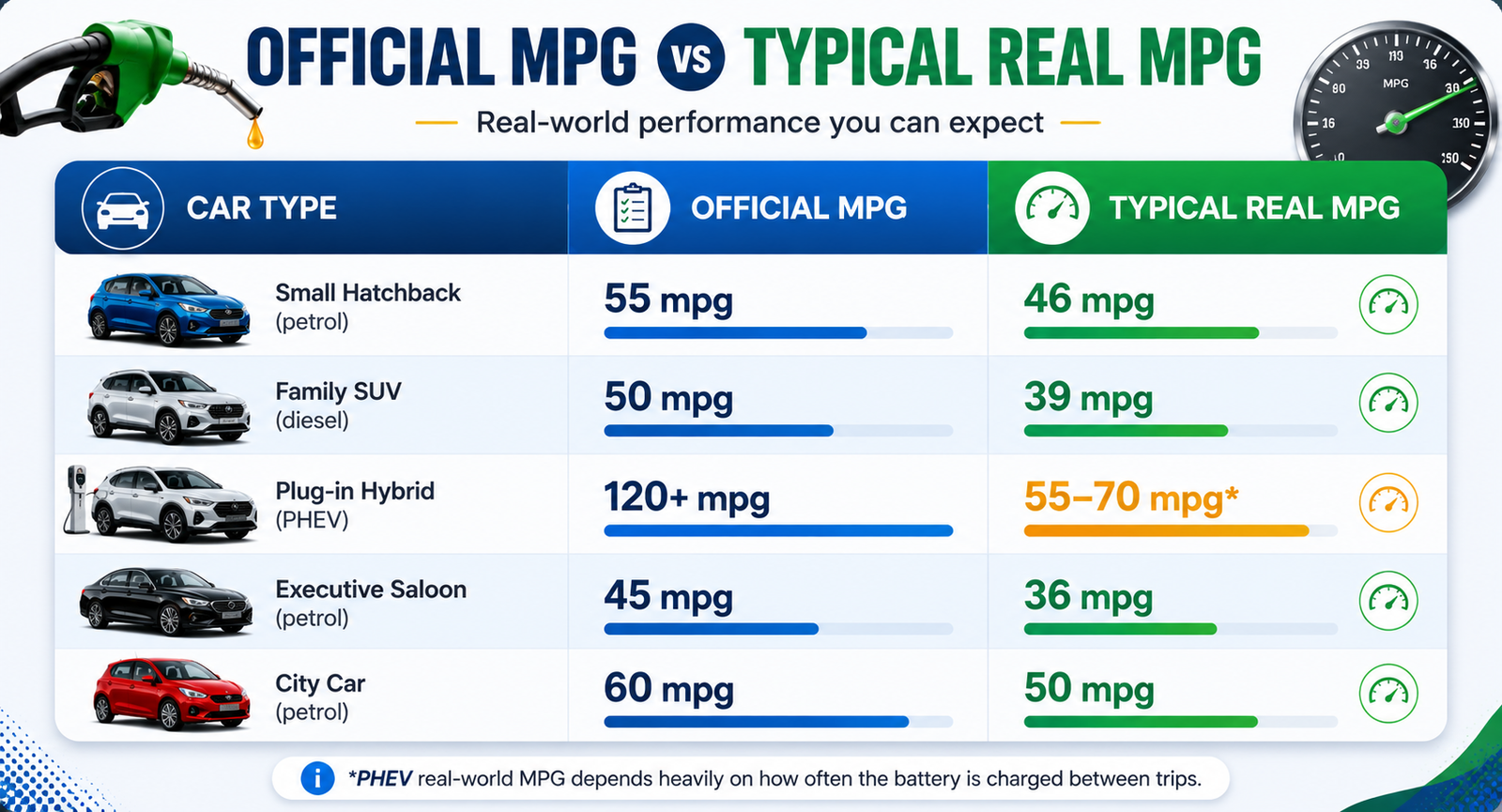
Typical real MPG compared with official figures across common UK car categories.
As the table shows, smaller, lighter cars tend to stay closer to their official mpg figure, while larger SUVs and plug-in hybrids usually show the widest gap. This is exactly why checking owner-reported fuel economy data before buying is so valuable — it gives you a genuinely realistic monthly fuel budget rather than a brochure best-case scenario.
How To Check A Car’s Real MPG Before You Buy
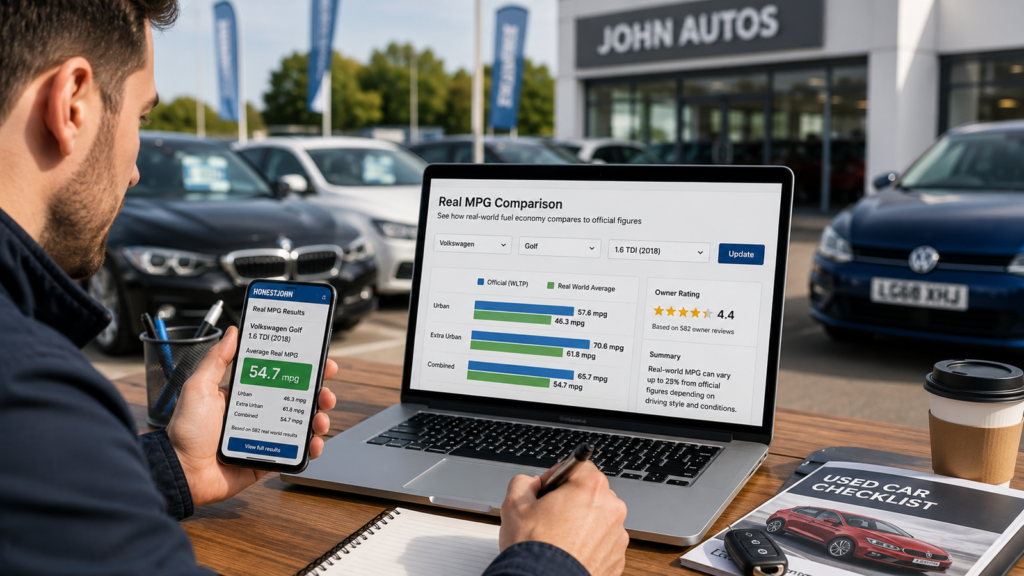
The good news is that checking this figure has never been easier. Here’s the process we’d recommend to anyone comparing cars:
- Search the specific make and model alongside “real mpg” to find owner-reported data from sites like Honest John.
- Compare at least three or four real-world reports, since individual driving styles can vary the figure significantly.
- Check whether reports specify mostly motorway, urban, or mixed driving — this changes the number a lot.
- For hybrids and plug-in hybrids, look specifically for real MPG figures from drivers who rarely charge, since this gives the more realistic worst-case number.
- Ask the dealership directly — our team at John Autos can talk you through typical real-world running costs for any car in our current stock.
7 Ways To Improve Your Car’s Real MPG
1. Keep Tyres Properly Inflated
Under-inflated tyres increase rolling resistance and can quietly reduce your fuel economy by several percent. Check pressures monthly against the figures in your door sill or handbook.
2. Drive Smoothly, Not Aggressively
Harsh acceleration and late braking burn noticeably more fuel than gentle, anticipatory driving. Smooth driving alone can close a meaningful chunk of the gap between official and real-world fuel economy.
3. Remove Unnecessary Weight And Roof Racks
Roof boxes, bike racks, and a boot full of unused items all add drag or weight, quietly dragging down your real-world fuel economy on every single journey.
4. Service Your Car On Schedule
A poorly maintained engine, clogged air filter, or worn spark plugs can all reduce your true fuel economy, sometimes significantly. Regular servicing keeps your car running as efficiently as the manufacturer intended.
5. Use The Right Gear At The Right Time
Manual drivers who change up early and avoid over-revving typically see noticeably better fuel economy than those who hold lower gears longer than necessary.
6. Plan Routes To Avoid Stop-Start Traffic
Stop-start driving is one of the biggest drains on real-world fuel economy. Where possible, route planning that favours steady-speed roads over congested ones can make a genuine difference.
7. Reduce Short Cold Starts Where Possible
Engines are least efficient in the first few minutes after a cold start. Combining several short local errands into one trip, rather than multiple cold starts, improves your average fuel consumption over time.
Petrol, Diesel, Or Hybrid: Which Holds Up Best In Real Driving?
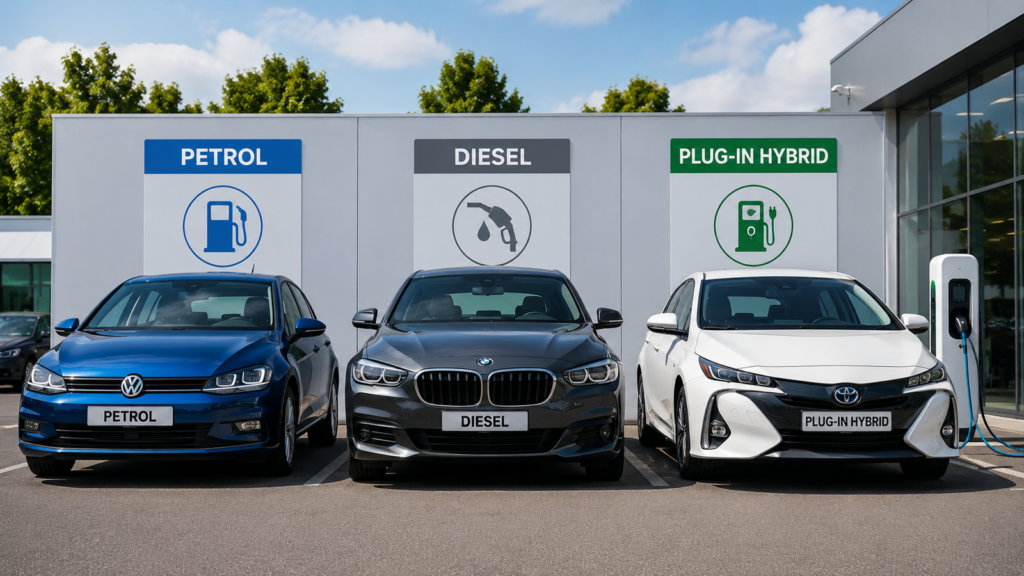
Engine type plays a big role in how closely a car sticks to its brochure figure. Modern petrol engines tend to be the most predictable, typically losing the smallest percentage versus their official number in mixed driving. Diesels can still offer strong long-distance economy on motorways, but short urban trips often eat into those savings more than owners expect.
Self-charging hybrids generally perform well in town, where the electric motor does much of the work at low speeds, but the advantage narrows considerably on faster roads. Plug-in hybrids show the most variation of all: drivers who charge nightly and stick to short commutes can comfortably beat the official figure, while those who rarely plug in often see numbers closer to a similarly sized petrol car, sometimes worse once the battery is depleted and the engine has to carry the car’s extra weight alone.
Real MPG And Buying A Used Car
When you’re choosing between used cars, true fuel economy should weigh just as heavily as the asking price, particularly if you’re covering higher annual mileage. A car that’s £500 cheaper to buy but costs an extra £400 a year in real-world fuel use isn’t necessarily the better deal once you do the maths over a typical 3-year ownership period.
It’s also worth factoring in how your own commute compares to the conditions a figure was recorded under. A car praised for brilliant motorway economy may disappoint a driver doing mostly short, urban journeys, while a car that looks merely average on paper might suit stop-start city driving better than its headline number suggests.
This is exactly the kind of detail our team considers when advising customers at John Autos. Browse our full range of quality used vehicles to compare running costs across our current stock, or get in touch with our Leighton Buzzard team for honest, real-world fuel economy advice on any car you’re considering.
For official efficiency ratings and the latest WLTP testing standards, you can also check the government’s fuel consumption and emissions guidance on GOV.UK, which explains exactly how official figures are produced and what they do and don’t take into account.
1. What does real MPG mean?
Real MPG refers to the fuel economy a car actually achieves in everyday UK driving, based on data reported by real owners, rather than the official figure produced under standardised laboratory test conditions.
2. Why is my real MPG lower than the advertised figure?
Official MPG figures come from controlled lab tests that don’t fully reflect traffic, hills, weather, or typical driving habits. Most cars achieve 15–25% less than their official figure in real-world UK conditions.
3. Where can I check a car’s real MPG before buying?
Owner-reported real MPG databases, such as those run by Honest John, are the most reliable source. Compare several reports for the exact make and model you’re considering, since individual driving styles affect the figure.
4. Do hybrid cars have a bigger gap between real and official MPG?
Yes, plug-in hybrids typically show the largest gap, since their official figures assume regular charging. Drivers who rarely plug in will see real MPG figures considerably lower than the advertised number.
5. Can I improve my car’s real MPG without buying a new car?
Yes. Keeping tyres correctly inflated, driving smoothly, removing excess weight, and keeping up with regular servicing can all noticeably improve your real-world fuel economy without any extra cost.