
Table of Contents
Road Tax 2026: The Honest Guide to What You’ll Actually Pay
By the John Autos Editorial Team • 9 min read • Updated June 2026
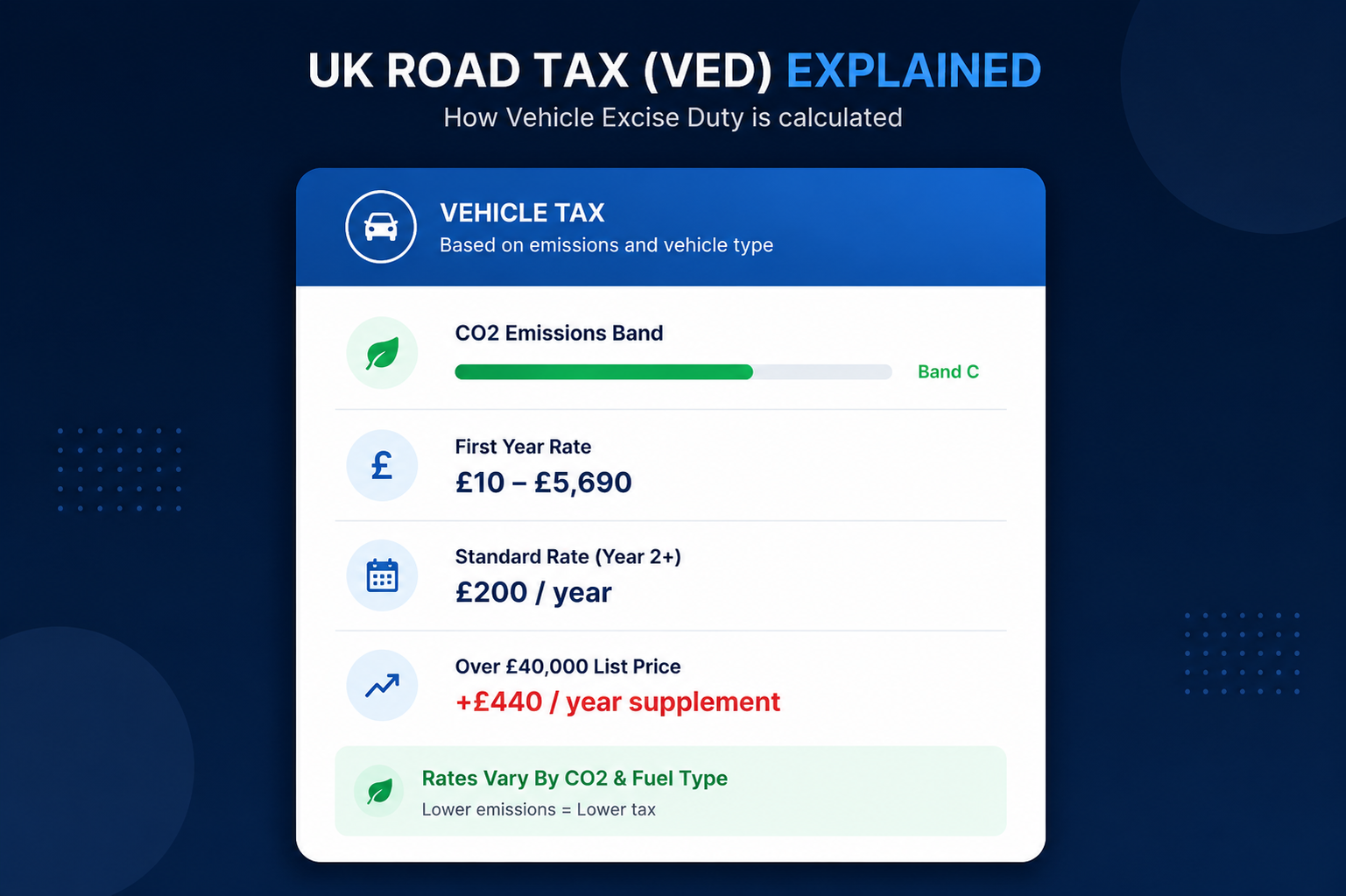
Road tax rates changed again in April 2026 — here’s exactly what UK drivers now pay.
Road tax is one of those costs every UK driver pays without necessarily understanding how the figure is actually worked out. With the rules changing again from April 2026, including the first time electric vehicles have faced a full standard charge, it’s easy to see why so many drivers head straight to Google to check exactly what they owe.
This guide breaks down road tax in plain English: how it’s calculated, what changed this year, and the practical steps that can keep your annual bill as low as possible. We’ll also cover the often-overlooked Expensive Car Supplement, what happens when you buy a used car, and how the rules differ depending on when a vehicle was first registered. Whether you’re budgeting for a new car or simply trying to understand your current bill, you’ll come away knowing exactly where your money is going and why.
What Is Road Tax?
Road tax, officially known as Vehicle Excise Duty (VED), is an annual charge collected by the DVLA that every car on a public UK road must have in place, whether the owner pays it directly or it’s included as part of a finance package. It isn’t legally tied to actual road maintenance funding any more, despite the name, but it remains compulsory — driving an untaxed vehicle is a criminal offence under the Vehicle Excise and Registration Act 1994.
Even if your specific vehicle happens to fall into a £0 tax band, you still need to formally tax it each year, or declare it off the road with a SORN if it won’t be driven or parked on a public road. Many drivers mistakenly assume a zero-rated car needs no paperwork at all, but the DVLA still requires the annual declaration, just without a payment attached.
Penalties for driving without valid tax are not trivial either. An automated system cross-references number plate recognition cameras against the DVLA database in real time, and an £80 fixed penalty notice (reduced to £40 if paid promptly) can follow almost immediately, with the possibility of court action and a far higher fine for repeat offenders.
How Road Tax Rates Are Actually Calculated
The amount you pay depends on three main factors: when your car was first registered, its fuel type, and its CO2 emissions. Cars registered after 1 April 2017 follow the current two-tier system, while older vehicles are taxed under previous rules based purely on emissions bands.

This is precisely why two seemingly similar cars can carry very different annual bills — a low-emission model registered last year and a higher-emission equivalent registered a few years earlier can sit in completely different parts of the system, even if they look near-identical on the road.
There’s also a third, older system still relevant to some used cars: vehicles registered between March 2001 and April 2017 follow a 13-band structure based entirely on CO2 output, with no separate first-year charge at all. If you’re considering a used car from this period, it’s worth checking which system applies before assuming the modern rates shown in most online calculators are relevant to that specific vehicle.
First-Year Rate vs Standard Rate: What’s The Difference?
Every new car pays a one-off first-year rate, sometimes nicknamed “showroom tax,” based entirely on its CO2 emissions at registration. From the second year onwards, almost all cars move onto the standard flat rate, which from April 2026 is £200 a year for petrol, diesel, hybrid, and electric cars alike.
Electric vehicles now follow the same pattern: a low £10 first-year charge, followed by the full £200 standard rate from year two — a significant change from the total exemption EVs enjoyed only a few years ago.
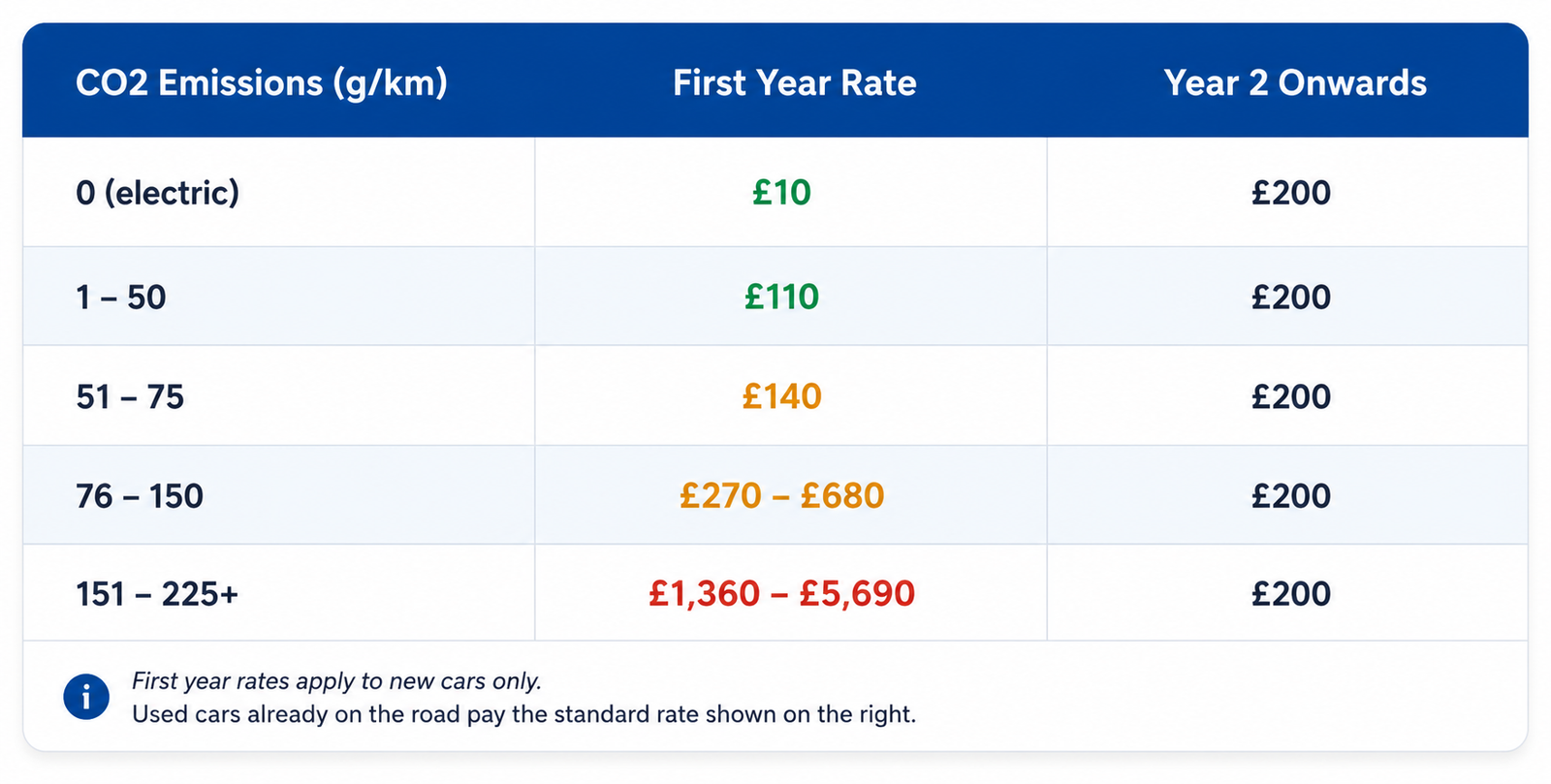
UK road tax rates by CO2 emissions band, effective from April 2026.
The Expensive Car Supplement Explained
If a car’s list price exceeded £40,000 when new (or £50,000 for electric cars registered from April 2026), an additional Expensive Car Supplement of £440 a year applies on top of the standard rate, for five years starting from the second year of registration. This catches more buyers than many expect, since the threshold is based on list price before any discounts, not what you actually paid.
It’s worth checking this carefully on premium hatchbacks and well-equipped SUVs, which can creep over the £40,000 mark once factory options are added, even when the base model sits comfortably under it.
7 Ways To Avoid Overpaying On Road Tax
- Check the exact CO2 figure before buying, not just the broad category, since small differences in emissions can shift a car into a noticeably higher band.
- Be cautious with optional extras on new cars, as they can push the list price over the £40,000 supplement threshold even if the standard model wouldn’t.
- Consider a slightly older used car already past its first-year charge, since it skips the showroom tax entirely and goes straight to the standard rate.
- Set up Direct Debit with the DVLA to avoid accidentally letting your tax lapse and facing fines or clamping.
- Declare SORN promptly if a car will be off the road for any length of time, rather than continuing to pay unnecessarily.
- Double-check your car’s tax band using the registration number rather than relying on memory or guesswork from a previous vehicle.
- Factor road tax into your total running cost comparison when choosing between cars, not just fuel economy and insurance.
Does Road Tax Affect A Car’s Resale Value?

Buyers increasingly factor ongoing running costs into their decision, and a car sitting in a high tax band can be noticeably harder to sell on, even at a discounted price. This has become more pronounced since electric vehicles lost their exemption, narrowing the running-cost gap that once made EVs an easy sell purely on tax savings alone.
For dealers and private sellers alike, being upfront about a car’s annual tax cost during a sale tends to build trust rather than scare buyers off — most people would rather know the figure honestly upfront than discover it as an unwelcome surprise after they’ve already committed to a purchase.
Buying A Used Car And Road Tax
When you buy a used car privately or from a dealer, tax does not automatically transfer with the vehicle — you must tax it again in your own name from the date of purchase, even if the previous owner’s tax hadn’t expired. The seller is entitled to a refund for any full remaining months, and you’ll need to arrange your own tax before driving the car away.
This is one detail that’s easy to overlook in the excitement of picking up a new car, but it’s a quick process you can usually complete online in a few minutes using the car’s logbook reference number.
At John Autos, our team always talks customers through the exact road tax band of any car in our current stock before they buy, so there are no surprises once you’re behind the wheel. Browse our full range of quality used vehicles to compare running costs across our current stock, or get in touch with our Leighton Buzzard team if you’d like help understanding the tax band on a specific car.
For the official, up-to-date rates and to tax your vehicle directly, you can visit the GOV.UK vehicle tax service, which is the only place to complete this legally and the safest source for checking current rates.
1. How much is road tax in the UK in 2026?
Most cars registered after April 2017 pay a standard road tax rate of £200 a year from their second year onwards. New cars also pay a one-off first-year rate based on CO2 emissions, ranging from £10 for electric cars to £5,690 for the highest-emission models.
2. Do electric cars pay road tax?
Yes, since April 2025 electric vehicles have lost their road tax exemption. They now pay a £10 first-year rate, then move onto the same £200 standard rate as petrol and diesel cars from year two onwards.
3. What is the Expensive Car Supplement?
It’s an additional £440 a year charged on top of the standard rate for cars with a list price over £40,000 when new (£50,000 for electric cars registered from April 2026). It applies for five years, starting from the second year of registration.
4. Does road tax transfer when you buy a used car?
No, road tax does not transfer with the vehicle. You must tax the car again in your own name from the date you buy it, even if the previous owner’s tax hadn’t expired yet. They can claim a refund for any full remaining months.
5. How do I check how much road tax I’ll pay on a specific car?
The most reliable way is to use the official GOV.UK vehicle tax checker with the car’s registration number, which shows the exact current rate based on that vehicle’s registration date and emissions.