
Table of Contents
PCP Vs HP Car Finance: 7 Honest Facts Before You Sign In 2026
By the John Autos Editorial Team • 7 min read • Updated June 2026
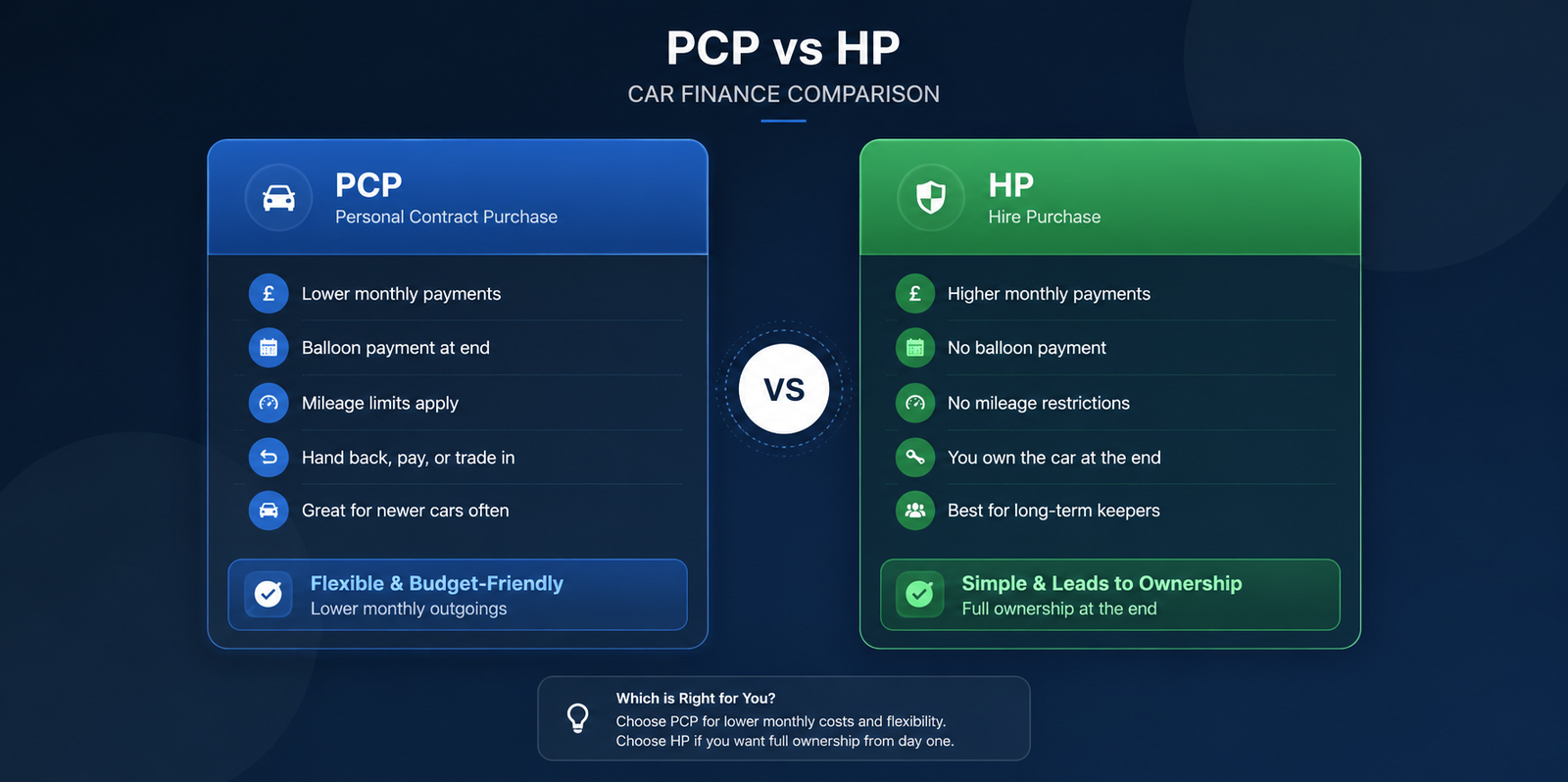
PCP and HP are the two most common ways UK drivers finance a car — but they work very differently.
Around nine in ten new cars in the UK are bought on finance, and the vast majority of those deals are either PCP or HP. If you’re comparing PCP vs HP car finance for the first time, the acronyms and the small print can feel overwhelming — but the core difference is actually simple once it’s explained in plain English.
This guide breaks down exactly how PCP vs HP car finance works, what you’ll actually pay, and which option tends to suit different types of driver. Whether you’re buying your next car from our Leighton Buzzard showroom or simply doing your research first, you’ll leave this page knowing exactly which finance route is right for you.
PCP Vs HP Car Finance: The Core Difference
The simplest way to understand PCP vs HP car finance is to think about what happens at the end of the agreement. With Hire Purchase (HP), you’re paying off the full value of the car in fixed monthly instalments, and once the final payment clears, the car is automatically yours. With Personal Contract Purchase (PCP), your monthly payments only cover the car’s expected depreciation, which keeps payments lower — but you’ll face a decision (and usually a large optional payment) at the end if you want to keep it.
How Hire Purchase (HP) Works
Hire Purchase is the more straightforward of the two finance types. You pay an initial deposit, typically 10–20% of the car’s price, then repay the remaining balance through fixed monthly instalments over an agreed term, usually 1 to 5 years. There’s no balloon payment and no mileage restrictions — once the final instalment is paid, ownership transfers to you automatically.
How Personal Contract Purchase (PCP) Works
With PCP, you also pay a deposit and monthly instalments, but those monthly payments are calculated against the car’s Guaranteed Minimum Future Value (GMFV) rather than its full price. At the end of the agreement, you typically have three choices: hand the car back with nothing more to pay, make a final balloon payment to own it outright, or trade in any equity towards a new PCP deal on a different car.
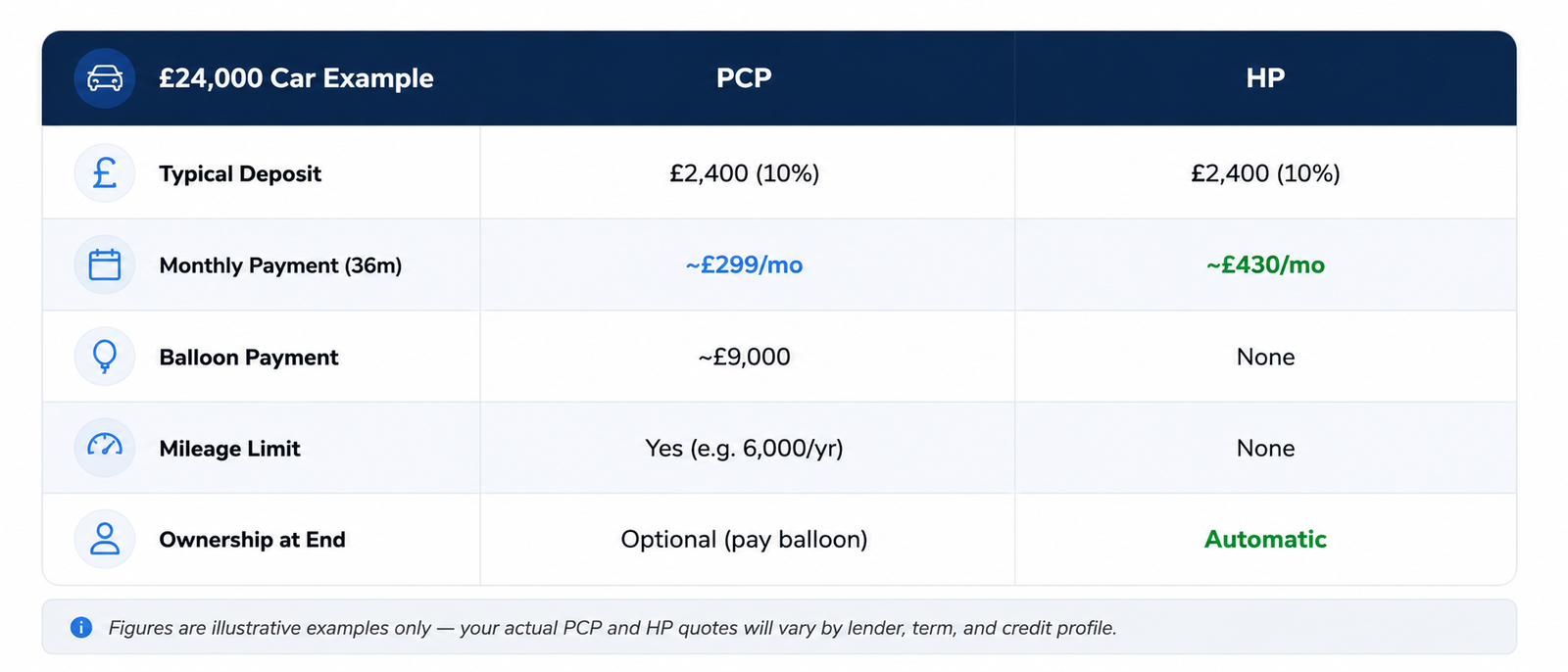
A simplified cost comparison for a £24,000 car on PCP vs HP car finance over 48 months.
7 Key Facts To Know Before You Choose
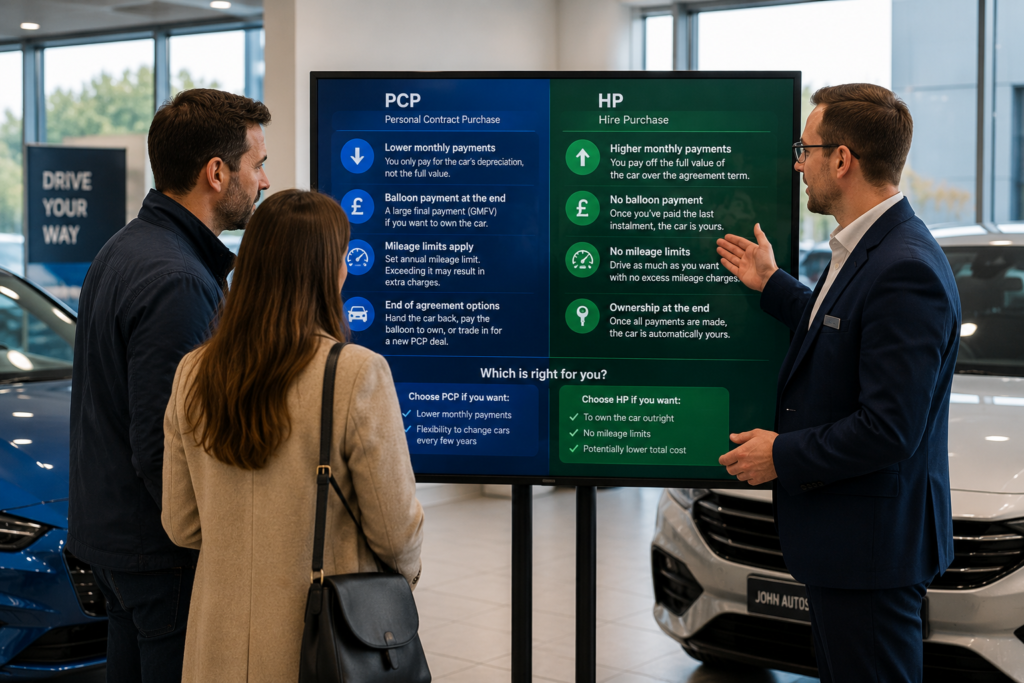
1. PCP Monthly Payments Are Usually Lower
Because PCP only covers depreciation rather than the car’s full value, monthly payments are typically 20–40% cheaper than the equivalent HP deal on the same car. This is one of the biggest factors drivers weigh when comparing PCP vs HP car finance.
2. HP Has No Mileage Limit
PCP agreements set an annual mileage cap, and exceeding it triggers excess mileage charges when you hand the car back. HP has no such restriction, since you’re working toward outright ownership regardless of mileage.
3. The Balloon Payment Can Be A Trap
If you want to keep your car at the end of a PCP deal, you’ll need to find the balloon payment, often several thousand pounds. Many drivers underestimate this and end up trading in or starting a new agreement instead of ever truly owning a car.
4. HP Often Costs Less Overall
Despite higher monthly payments, Hire Purchase frequently works out cheaper across the full term when you account for the PCP balloon payment, particularly if your goal is long-term ownership.This is a key consideration in the PCP vs HP car finance decision for long-term owners.
5. PCP Suits Drivers Who Like To Change Cars Often
If you enjoy driving a newer car every few years and don’t want the hassle of selling privately, PCP’s flexibility to simply hand the car back (subject to fair condition and mileage) can be genuinely convenient.
6. Both Are Regulated Credit Agreements
Both PCP and HP fall under the Consumer Credit Act, giving you a statutory cooling-off period and the right to settle early. You can find full details of your consumer credit rights on the official GOV.UK car finance guidance page. This legal protection applies equally whichever side of the PCP vs HP car finance debate you land on.
7. Your Credit Score Affects The Rate On Both
Whichever you choose, the APR you’re offered on PCP vs HP car finance depends heavily on your credit history, deposit size, and the lender’s own criteria — so it’s always worth comparing more than one quote.
PCP Vs HP: Which Should You Choose?
There’s no single right answer to the PCP vs HP car finance question — it depends entirely on your priorities. Choose PCP if lower monthly payments and the flexibility to change cars regularly matter most to you. Choose HP if outright ownership, no mileage limits, and a typically lower total cost over the full term are more important.
- Want the lowest possible monthly payment? PCP usually wins.
- Want to own the car outright with no final lump sum? Choose HP.
- Drive high annual mileage? HP avoids excess mileage penalties.
- Like changing cars every 2–3 years? PCP’s flexibility suits you better.
Ultimately, the right PCP vs HP car finance choice comes down to how you use your car day to day.
Get Tailored Car Finance Advice At John Autos

Every driver’s situation is different, and the best way to settle the PCP vs HP car finance debate for your own budget is to talk it through with a specialist. Browse our full range of quality used vehicles at John Autos, or get in touch with our Leighton Buzzard team for clear, no-pressure finance advice tailored to how you actually drive.
1. What is the main difference between PCP and HP car finance?
The main difference in PCP vs HP car finance is ownership. With HP, you automatically own the car once the final payment is made. With PCP, you only own the car if you pay an additional balloon payment at the end of the agreement.
2. Is PCP or HP cheaper overall?
PCP usually has lower monthly payments, but once you factor in the balloon payment needed to own the car, HP often works out cheaper overall if your goal is outright ownership. PCP tends to be better for cash flow rather than total cost.
3. Can I pay off my PCP or HP agreement early?
Yes, both PCP and HP are regulated under the Consumer Credit Act, which gives you the legal right to settle your agreement early. You may need to request a settlement figure from your finance provider first.
4. Does PCP have mileage limits?
Yes, PCP agreements set an annual mileage allowance, and exceeding it usually results in an excess mileage charge when you return the car. HP has no mileage restrictions since you’re working toward full ownership.
5. Which is better, PCP or HP, for a used car from John Autos?
It depends on your goals. If you want the lowest monthly payment and like changing cars regularly, PCP may suit you better. If you want to own your car outright with no large final payment, HP is usually the simpler choice. Our Leighton Buzzard team can talk through both options based on your budget.
6.Can I switch from PCP to HP halfway through an agreement?
Switching directly from PCP to HP mid-agreement isn’t standard practice, but you can settle your PCP early (using a settlement figure from your lender) and start a fresh HP agreement on the same or a different car. Our team can help you work out whether this makes financial sense in your PCP vs HP car finance situation.
7.Do I need a large deposit for PCP or HP?
Both PCP and HP typically require a deposit of around 10–20% of the car’s value, though some deals are available with no deposit. A larger deposit reduces your monthly payments on either type of agreement, which is worth factoring in when comparing PCP vs HP car finance options.
8.What happens if I damage the car on a PCP agreement?
PCP agreements include “fair wear and tear” guidelines, and damage beyond this can result in extra charges when you return the car. This is one of the key risks to weigh up in the PCP vs HP car finance decision, since HP carries no such condition requirements once you own the car outright.